€599.00 *
Prices incl. VAT, free shipping worldwide
Ready to ship today,
Delivery time appr. 3-6 workdays

Hermes Bronze Statue – Giambologna on Marble - Signed The celebrated Hermes Bronze Statue,... more
Product description
"Hermes Statue - Hermes God - Bronze"
| Weight | 6,2 kg |
Hermes Bronze Statue – Giambologna on Marble - Signed
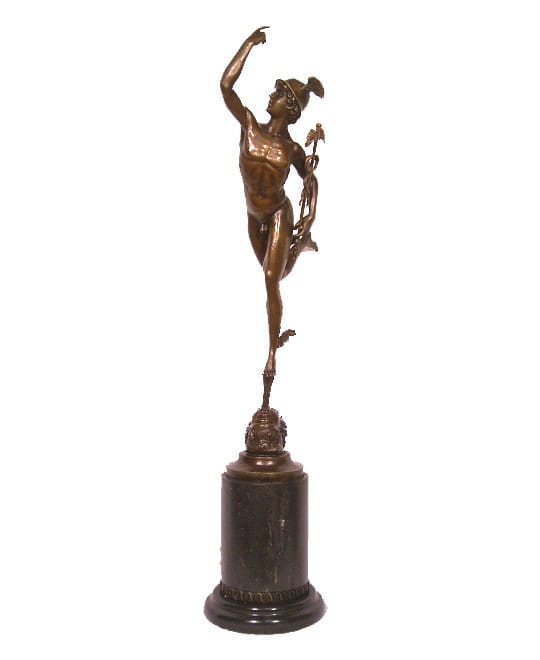
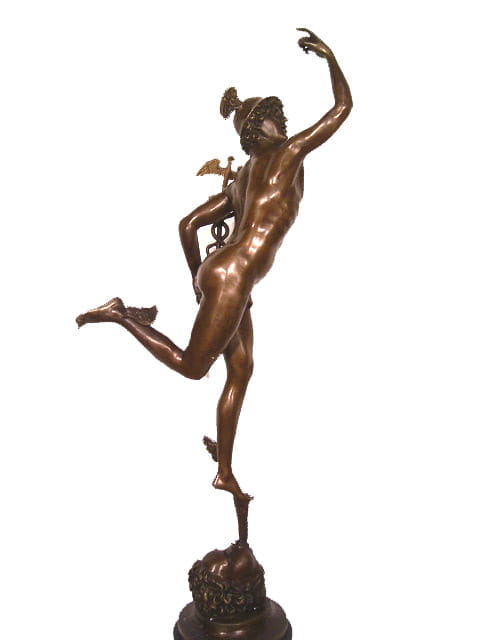
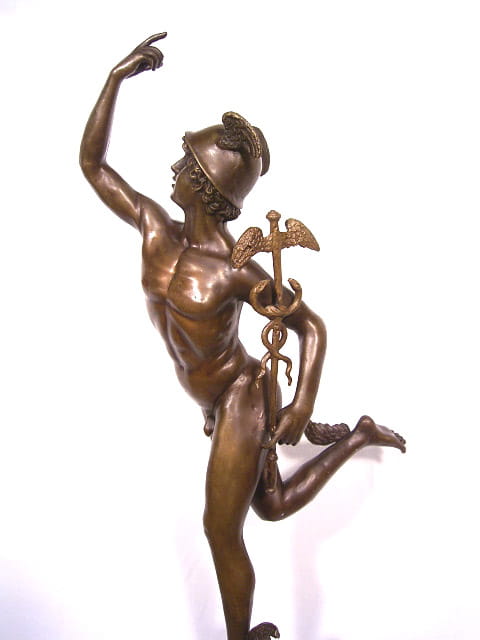
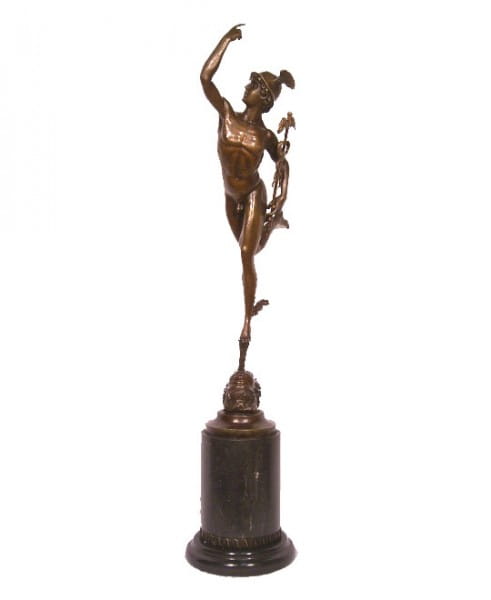
The celebrated Hermes Bronze Statue, often known as the Flying Hermes, captures the messenger of the gods in a moment of suspended ascent, balancing effortlessly on a breath of motion. The youthful Hermes God rises upward with one arm lifted toward the heavens, while the other guides the body in a spiral of perfect equilibrium. His anatomy is idealized, elongated, and refined, revealing tension without strain and elegance without weight. The subtle twist of the torso and the poised extension of the legs create an illusion of flight rather than movement. As a Hermes Statuette, the sculpture embodies grace, speed, and divine intelligence. It stands as one of the most admired interpretations of the Hermes Statue in sculptural history.
Movement Shaped into Balance
The composition of this Hermes Statue is defined by vertical momentum and astonishing control. The figure appears to rise effortlessly from the marble base, supported by a discreet element that enhances the illusion of levitation. Every line of the body contributes to upward flow, from the pointed toes to the raised hand. Musculature is precisely modeled, emphasizing harmony rather than physical force. This refined balance transforms motion into visual poetry. The Hermes God is presented as the embodiment of speed and clarity.
Anatomy and Sculptural Precision
The surface of the bronze reveals Giambologna’s mastery of anatomical proportion and rhythmic contour. Smooth transitions across the chest, abdomen, and limbs create a continuous visual cadence. The head tilts slightly upward, reinforcing a sense of alertness and divine purpose. Facial features are serene, almost detached, underscoring the god’s transcendence above mortal concerns. Light glides across the polished bronze, animating the form without disrupting its calm. Such refinement defines the enduring power of the Hermes Statuette.
Mythological Meaning and Presence
As the divine messenger, the Hermes God symbolizes communication, travel, and transformation. This sculpture distills those attributes into posture and balance rather than narrative detail. The absence of excess symbolism allows the figure itself to convey meaning through form. The upward thrust suggests both physical flight and intellectual elevation. This abstraction grants the Hermes Statue timeless resonance. It becomes a universal symbol of movement guided by intelligence.
Placement and Interior Harmony
This sculpture is ideally displayed on a pedestal, console, or architectural niche where its verticality can be fully appreciated. Positioned at eye level or slightly below, the illusion of ascent becomes most compelling. The marble base anchors the composition while contrasting elegantly with the warm bronze surface. Neutral surroundings allow the figure’s silhouette to command attention. As a Hermes Statuette, it integrates seamlessly into both classical and modern interiors. Its presence introduces elevation rather than dominance.
Museums and Historical Visibility
Original and cast versions of Giambologna’s Hermes can be seen today in major museum collections. Notable examples are preserved in Florence, Paris, London, and Vienna, where they remain central to permanent displays. These institutions recognize the sculpture as a landmark of European bronze casting. Its continued exhibition affirms its historical and cultural significance. Each Hermes Statue serves as a reference point for sculptural excellence. The figure remains admired across centuries.
Giambologna
Giovanni da Bologna, known as Giambologna, was born in 1529 in Douai, in what is now France, into a Flemish family of modest means. He trained initially in the Low Countries before traveling to Italy, where he studied classical antiquities and the works of Michelangelo. Settling in Florence, he entered the Medici court and became its leading sculptor. His ability to create complex compositions viewable from all angles brought him international fame. The Hermes Bronze Statue was first conceived around 1580 in Florence and refined over time. Giambologna died in Florence on August 13, 1608.
The celebrated Hermes Bronze Statue, often known as the Flying Hermes, captures the messenger of the gods in a moment of suspended ascent, balancing effortlessly on a breath of motion. The youthful Hermes God rises upward with one arm lifted toward the heavens, while the other guides the body in a spiral of perfect equilibrium. His anatomy is idealized, elongated, and refined, revealing tension without strain and elegance without weight. The subtle twist of the torso and the poised extension of the legs create an illusion of flight rather than movement. As a Hermes Statuette, the sculpture embodies grace, speed, and divine intelligence. It stands as one of the most admired interpretations of the Hermes Statue in sculptural history.
Movement Shaped into Balance
The composition of this Hermes Statue is defined by vertical momentum and astonishing control. The figure appears to rise effortlessly from the marble base, supported by a discreet element that enhances the illusion of levitation. Every line of the body contributes to upward flow, from the pointed toes to the raised hand. Musculature is precisely modeled, emphasizing harmony rather than physical force. This refined balance transforms motion into visual poetry. The Hermes God is presented as the embodiment of speed and clarity.
Anatomy and Sculptural Precision
The surface of the bronze reveals Giambologna’s mastery of anatomical proportion and rhythmic contour. Smooth transitions across the chest, abdomen, and limbs create a continuous visual cadence. The head tilts slightly upward, reinforcing a sense of alertness and divine purpose. Facial features are serene, almost detached, underscoring the god’s transcendence above mortal concerns. Light glides across the polished bronze, animating the form without disrupting its calm. Such refinement defines the enduring power of the Hermes Statuette.
Mythological Meaning and Presence
As the divine messenger, the Hermes God symbolizes communication, travel, and transformation. This sculpture distills those attributes into posture and balance rather than narrative detail. The absence of excess symbolism allows the figure itself to convey meaning through form. The upward thrust suggests both physical flight and intellectual elevation. This abstraction grants the Hermes Statue timeless resonance. It becomes a universal symbol of movement guided by intelligence.
Placement and Interior Harmony
This sculpture is ideally displayed on a pedestal, console, or architectural niche where its verticality can be fully appreciated. Positioned at eye level or slightly below, the illusion of ascent becomes most compelling. The marble base anchors the composition while contrasting elegantly with the warm bronze surface. Neutral surroundings allow the figure’s silhouette to command attention. As a Hermes Statuette, it integrates seamlessly into both classical and modern interiors. Its presence introduces elevation rather than dominance.
Museums and Historical Visibility
Original and cast versions of Giambologna’s Hermes can be seen today in major museum collections. Notable examples are preserved in Florence, Paris, London, and Vienna, where they remain central to permanent displays. These institutions recognize the sculpture as a landmark of European bronze casting. Its continued exhibition affirms its historical and cultural significance. Each Hermes Statue serves as a reference point for sculptural excellence. The figure remains admired across centuries.
Giambologna
Giovanni da Bologna, known as Giambologna, was born in 1529 in Douai, in what is now France, into a Flemish family of modest means. He trained initially in the Low Countries before traveling to Italy, where he studied classical antiquities and the works of Michelangelo. Settling in Florence, he entered the Medici court and became its leading sculptor. His ability to create complex compositions viewable from all angles brought him international fame. The Hermes Bronze Statue was first conceived around 1580 in Florence and refined over time. Giambologna died in Florence on August 13, 1608.
Wide: 15 cm
High: 71 cm
Depth: 20 cm
Weight: 6,2 kg
100% Bronze
High: 71 cm
Depth: 20 cm
Weight: 6,2 kg
100% Bronze
Related links to "Hermes Statue - Hermes God - Bronze"
Read, write and discuss reviews... more
Customer evaluation for "Hermes Statue - Hermes God - Bronze"
Write an evaluation
Evaluations will be activated after verification.
Our advantages
free shipping
Worldwide free shipping
14 days money back
You can cancel your order
within 14 days
secure payment services
Paypal, Master Card, Visa, American Express and more